
Open Models, Closed Networks
How AI will radically reshape the networks we use to share & interact with each other.

Thank you to the closed network of Andy Weissman, Benny Giang, Drew Austin, Eric Paley, Mat Dryhurst, Maxime Eyraud, Natalie Mullins, Nick Susi, Patrick Montague, Reggie James, Soren Wrenn, and Yancey Strickler for reviewing drafts of this piece.
1. Tech loves a theme, but a theme ≠ the truth
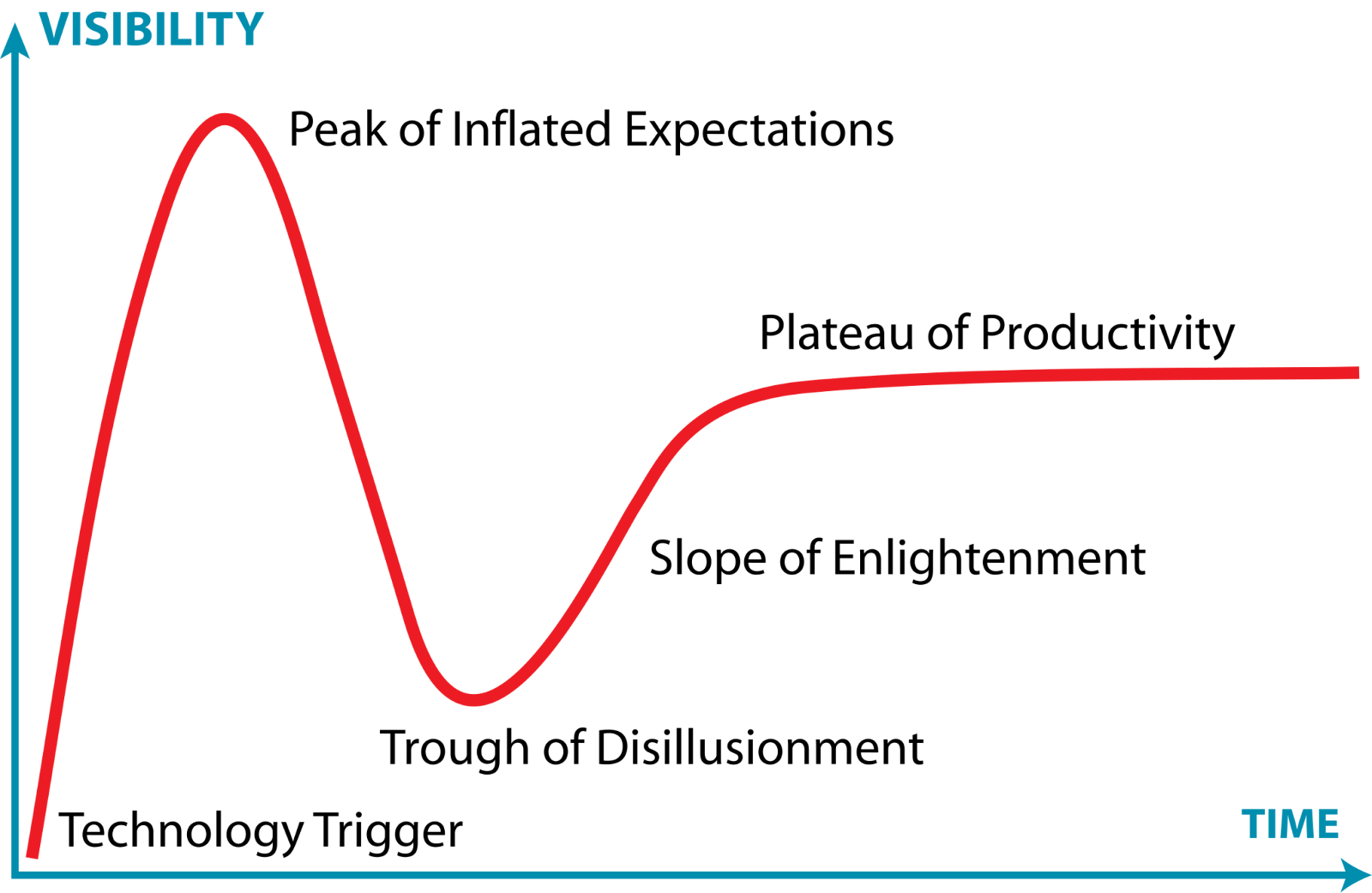
Have you ever had this feeling? That the tech discourse can overamplify the trend of the moment?
Or that a certain segment of (American) folks in tech underplay the forces that will actually reshape our well-being for years to come — while they herald certain products as innovative and world-altering even though they fail to leave a mark on our present or future daily lives?
Who can relate (woo)?
Some people can get carried away with the theme du jour. There is a well known fund that rebranded themselves from their original name to "[Original Name] + Crypto" and then back to their original name all within the span of 3 years.
Who remembers how popular “cleantech” was in 2008? Or “VR/AR/XR” in 2015 after Meta acquired Oculus 2 years prior?
While the Peak of Inflated Expectations is a natural part of the new tech category lifecycle, this phenomenon of all tech discourse converging around one theme feels more intense than ever before.
Maybe this one track view of the future is more intense than ever because of the social media environment we’re in. We’ve never been more exposed to the thoughts of others in a never-ending tsunami.
Tsunami water is rarely the cleanest. Industry convergence around an idea of the future is not always in line with what the future actually brings – or which part of the future actually matters.
2. Today's theme is AI. Tomorrow's truth is closed networks.

This groupthink is caused in part by today's open networks and social media environment – and in part by human nature – and will only get worse as AI spreads on these open networks.
Soon, those who are searching for quality information – aligned with truth and value in the long-term agnostic of what the crowd thinks – will begin to seek out closed networks.
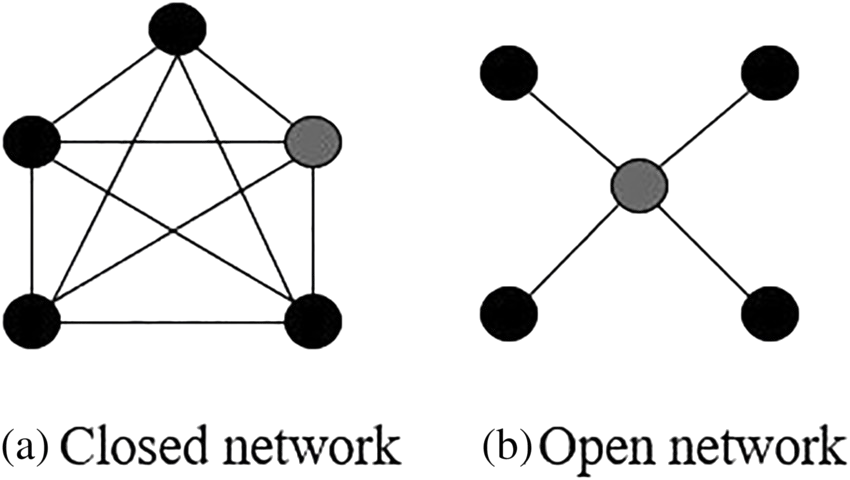
Open networks can be defined as networks where all sides of the network are open to all, and the only filters (if any at all) are around NSFW content rather than who can join. Most of the hyperscale, advertising-based social media networks that occupy our time today are designed as open networks.
We can define a closed network as a network that is somewhat gatekept or where the nodes have been intentionally selected —that includes self-selection — in line with the ethos of the network.
Another way of defining a closed network is a network defined by what’s left outside of the network as much as by what's inside the network.
Large closed networks are for anyone, but not for everyone.
This shift towards closed networks is likely to be the biggest impact of AI on the average person’s life outside of work.
AI will be transformative, but neither its second-order effects nor the low barriers to entry for products in the space are being sufficiently discussed.
The rise of closed networks will accelerate due to (1) AI on the consumer software products & social networks we use changing our relationship to information and due to (2) AI on the consumer software products & social networks we use changing our relationship to other humans.
Not only is AI changing what we see on software products and social networks, but it is also (3) changing our relationship to consumer software and social networks themselves. All three of these reasons portend closed networks. Open models beget closed networks.
Evidence of this can be found in digital ecosystems where the value of information is the most quantifiable and impactful, and in niche but increasingly influential parts of the Internet.
These ecosystems serve as natural experiments on how valuable information and interactions are shifting from open networks to closed networks.
3. Open-source AI models cause AI ubiquity on the consumer Internet
The launch of Deepseek as an open-source, low-cost alternative to foundational models from companies like Open AI, Anthropic, Alphabet and Meta will make AI ubiquitous and omnipresent not just in the world of enterprise software – where AI is most lucrative and present today – but in consumer software as well.
Strong open-source, low-cost AI models will make high-quality AI output indistinguishable from human user output and will have the ability to flood our existing, open network consumer spaces.
This will make it very hard to tell what is real or true on existing social networks when anyone can upload anything — even with tools like Community Notes. Have you ever stepped on what you thought was stable ground but turned out to be black ice? This is the level of disorientation that will occur on existing open network platforms from "synthetic media".
This will result in lower user-to-user and overall platform trust on our existing open network social media, in a way eerily similar to the loss of trust in “mainstream” media. Open networks are now mainstream media.
The logical conclusion from this is that open networks will erode in value over time and closed networks will grow.
This is not a hypothetical, crystal ball prediction of the future. This future is already here; it’s just unevenly distributed.
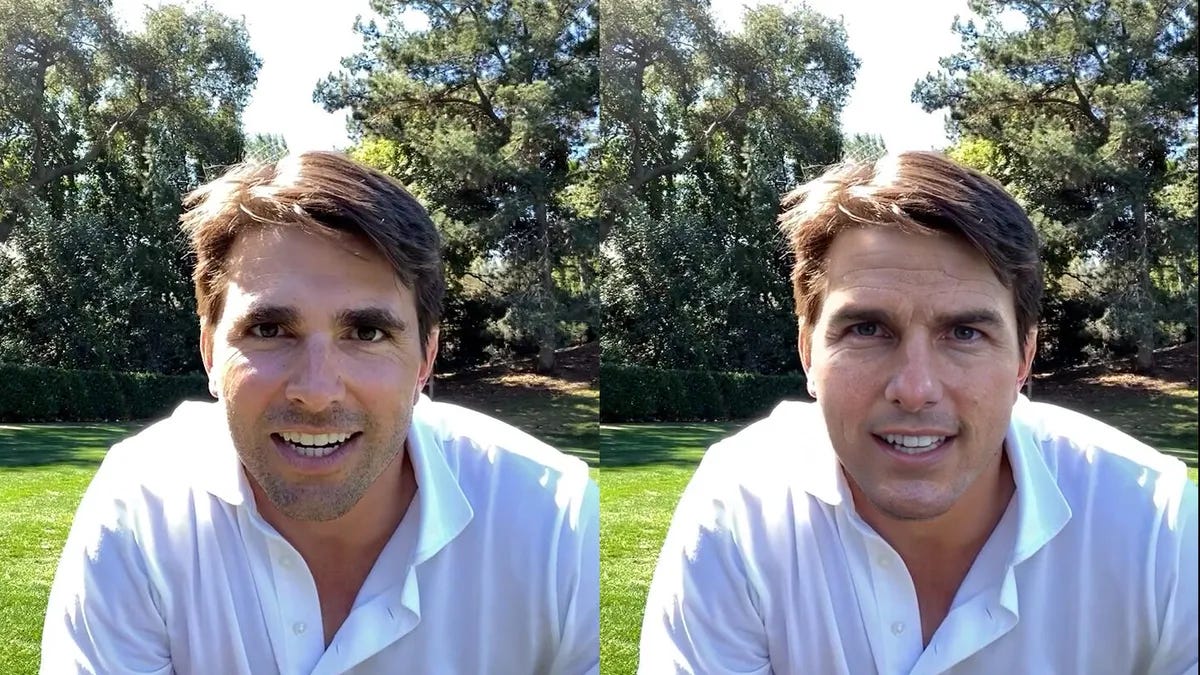
There have already been deepfake scandals and viral moments with politicians like Nancy Pelosi and Ukrainian prime minister Volodymyr Zelensky and celebrities like Tom Cruise and The Weeknd.
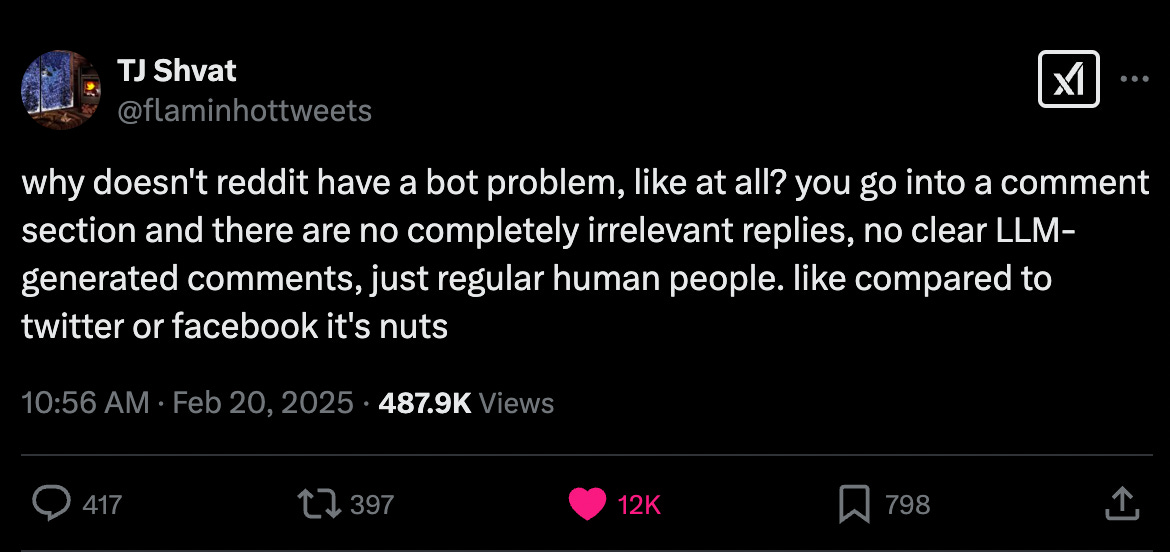
As a result, if you go to a music subreddit now, you'll often see fans debating whether a leak – the crown jewel of these subreddits – was even made by their favorite artist.
4. AI is reshaping our relationship to information & its utility
Let's take another part of the Internet that seems niche but is growing in influence – memecoins. Memecoin trading is the most hyper-utilitarian part of the Internet today. The traders in this space are concerned with nothing else besides making money in the shortest amount of time.
This corner of the Internet therefore provides an illustrative glimpse into how AI changes the utility of information and what happens when AI becomes ubiquitous, as it's the corner where the value of information is the most quantifiable.
Bots are versions of AI and are omnipresent in the memecoin space. A lot of bot usage happens in ways that are invisible to the average outside observer.
Trading bots like Banana/Trojan/Bonk Bot ensure retail speculators have the fastest possible trading times. People interact with anti-rugging bots like Antibxt to understand whether a coin's supply is concentrated in the hands of a few to avoid losing money. Savvy traders even code their own bespoke bots to trade automatically.
The ubiquity of these bots has created a very tough market where any alpha is exploited very quickly, and 90-95% of people lose money.
Because of these harsh dynamics, people are very eager to pump and promote their coins so that they can get more buyers in and drive the price up before they sell.
Some use bots to constantly promote the coins they own on social media and to respond to influencers with big audiences.
This is the most visible manifestation of AI and bots in crypto for an outside observer. Just search the contract address for any Solana memecoin with a decent amount of volume and you will see dozens of identical messages sent from similar Twitter accounts with almost no followers promoting a coin.
The ubiquity of these AI bots in both the purchasing and promotion of memecoins has led to a very interesting phenomenon.
Where the money is made in memecoins is increasingly in private, members-only Discords, Twitter DM groups or Telegram networks. These closed networks allow traders to compare notes and flag interesting memecoins as early as possible, way before coins reach the level of engagement necessary to be picked up by algorithms on traditional social networks.
The vetting of each member in these closed networks ensures a much denser quality of information and feels much more aligned with each member's interests when it's clear who is human and you can understand each human’s goals and motivations.
Even the less ethical ways of making money in memecoins still revolve around closed networks. Closed networks — or “cabals” — are where the money is made for those in the know, with key opinion leaders inside trading as they privately discuss which coins they’re going to buy, which coins they’re going to pump, and when they are going to sell – as evidenced by the recent $LIBRA scandal.
You would think that the dynamics of memecoins – where you make money if you create widespread demand – would incentivize mass communication on open networks.
However the backlash for sharing a coin that causes people to lose money — which is the vast majority of coins — is so severe that some influential voices are afraid to share the contract addresses of the coins that they believe in, even if it might be in their short-term best interest to do so.
One can use what is happening with memecoins to see what is happening and what will happen in other utility-driven information markets.
The movement towards closed networks already exists with the written word. Think of how existing open social networks have been overrun with misinformation, distortion of fact, and biased opinion and how Substack (where this piece lives) has risen out of that world.
The business model of most Substacks – member subscriptions – closes the membership side of the network to those willing to pay, creating a filter for and level of intentionality in the members who join and interact with the specific Substack.
Even without the subscription payment, the self-selecting nature of those who subscribe and certain posts being only for them makes the network closed.
You can also point to the rise of creator collectives on open platforms like Twitch and YouTube to show the value of closed networks within larger open networks.
Many of the biggest creators on these platforms are part of invite-only collectives that collaborate on videos together and cross-pollinate audiences – like Kai Cenat being a part of AMP or Jasontheween being a part of Faze – and connect with their audiences on Discord as much as YouTube.
In an era where we are flooded with information and content, the most valuable information comes from networks that we trust to deliver us quality, and the networks we trust are inherently closed to some degree to maintain their quality and ethos. The incentives of open networks do not reward this quality.
5. AI is changing our relationship to other people online & ourselves
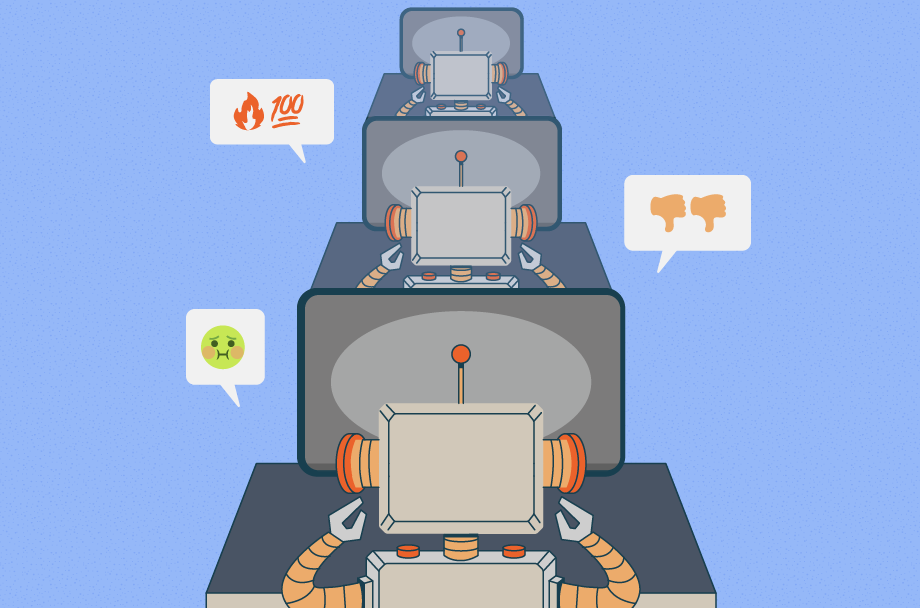
In addition to the utilitarian reasons around the average piece of information being more likely to be quality in a closed network, there are also some important psychological reasons why closed networks are becoming more important in an age of AI ubiquity.
Think of how concerts and festivals boomed in popularity as digital music became ubiquitous and you'll have a playbook for how AI agents make us crave the feeling of human connection.
It’s surprising for example that even participants in very online, technologically forward corners of the Internet like PC gamers are rejecting AI in a search for human connection. To quote a post in a popular Steam thread petitioning for Steam to ban all games with generative AI, "I don't want to play a game nobody wanted to make. I want to play things people made, who love what they've created."
This craving for humanity is also why we’re slowly gravitating towards closed networks, because they allow us to feel a more intimate and human bond with the network's members – both with the other members who are consuming information or content on the network like us and with the members that are creating information or content on the network.
For example, though open to anyone, a vertical-specific platform like Letterboxd is extremely self-selecting in terms of who joins and uses it, and that creates a much more intimate community that feels much more human than an open social network designed to be mass.
Self-selecting networks refer to networks that are actively chosen by individuals based on a knowledge of self and one’s worldview or interests — rather than networks individuals are passively steered to based on algorithms.
Beli is another example of how a vertically integrated app centered around a specific interest fosters more intimate and meaningful digital connections. Strava (biking/fitness), Alltrails (hiking), and Fishbrain (fishing) are similar examples in different categories. You can also see the power of these vertically integrated apps in Chinese social networks like Hupu (originally for basketball fandom) or Xiami Music.
This world resembles the digital version of a trend happening in the physical world in NYC, where new exclusive members' clubs and gyms are popping up every day, and also resembles how run clubs are popping up worldwide.
In both these digital and IRL trends, there’s a move towards common interest and shared hobbies as a means of finding identity, community and status as we wade through the digital tsunami.
It's safe to assume then that closed networks around the consumption of specific media like movies, music, and games – given media's inherently digital, non-geographically bound nature and its role in forming identity and community – will also grow in influence.
So too will closed social networks around specific political beliefs and religions given the similar tribalism of both fields. Just look at the rise of right-wing"alt-tech" and huge religious apps like Hallow and Muslim Pro.
The more AI is omnipresent, the more we quietly yearn for the feeling of human connection and the ability to relate to others. AI doesn't solve the fundamentally human and psychological needs of community, social status, and identity – it amplifies them.
6. AI is changing our relationship to software itself

Closed networks will rise as AI becomes ubiquitous not only for both utilitarian and psychological reasons but also because AI is fundamentally changing our relationship to software itself.
Not only does the flooding of traditional networks with AI-generated information cause us to crave the psychological values of community, status and identity more, but these psychological values are becoming more important as AI is making it easier and easier to create software products.
It's now possible to create entire Star Wars videogames in 2 hours without writing a line of code.
The ability to build any software using a natural language prompt in Deepseek, Replit, Cursor, or Windsurf shifts the value of a software product away from its features towards its network.
When the network matters more than the features, the quality of the nodes and edges in the network matter more than the quantity, as quantity is something that is easily generated by AI or easily gamed.
To quote Natalie Mullins who reviewed this essay: “The network is now the platform and the platform is merely an interface.”
Post-AI ubiquity, the psychological values of a network and a company begin to matter more than the utility of the product associated with that network because anyone can easily replicate any feature of any software product. What matters more and more for digital business success in this world is the brand of the product and how the product makes consumers feel.
A lot of how we feel in network contexts is predicated on in-group / out-group dynamics – see the minimal group paradigm study – and therefore closed networks are one of the most powerful ways to generate strong feelings for consumers, as the network's closed nature gives it meaning in our brains.
Closed networks also allow for the clearest definition of values and aesthetics within a network, as they can use the gatekeeping of nodes to define these values and aesthetics.
When people refer to taste and aesthetics becoming more important and "taste eating Silicon Valley", they are implicitly referring to the importance of closed networks of people who have specific views of what taste is and who influence others' definitions of taste as a key determinant in business success.
The combination of AI’s ability to compete with any utility-based value proposition and the low barriers to entry for building in AI make psychological value propositions all the more important for what people crave and successful business outcomes.
There's also one more way that AI will cause closed networks to grow by changing how software works and it's arguably the most obvious. AI causes closed networks to flourish in part because open networks are more easily scrapeable.
If you’re an Internet user who doesn't want your data to be used as training data for a model — or you’re a company that doesn't want your data to be mined for free — you will want to exist in places that are gatekept away from the scraping that underpins so many foundational models.
7. Existing large-scale closed networks will grow in influence
By now it should be clear that open models are going to cause AI to be ubiquitous, and that the ubiquity of AI will cause closed networks to proliferate for utilitarian reasons, psychological reasons, and the shift away from utility towards psychology as AI coding tools become widespread.
This is not an entirely new phenomenon. There are already several successful closed network businesses that have grown in value over the past 5-10 years. Reddit, Discord, Telegram, Hermes, Netflix, SSENSE, and HBO are all examples of multibillion-dollar companies who take advantage of closed networks for business success.
Reddit in particular is worth studying more closely.
A branching tree-like structure of closed networks – where people can create closed networks themselves and have them be subgroups or spinoffs of larger closed networks – could allow for an overall closed network to achieve a sizable userbase.
Reddit is one of the most unique social media networks today as it upholds the idea of there being "riches in niches" better than any other and is explicitly organized by interests. Discord has a similar structure too, minus the existence of one overall Discord linking individual servers together.
What Reddit and Discord both have in common is that they enable users to create closed networks to discuss topics that they are interested in – and allow for the use of pseudonymous identities to do so. In some ways, this feels more human than the networks based around real world identity that can quickly become performative.
It's possible to envision versions of Reddit and Discord that are even more in line with closed networks. What if Discord was vertically integrated and people could consume content or play games in the same place that they converse about the content and games? What if there were more members-only, private subreddits? Or more subscription-based subreddits the way that there are many subscriber-only Discords?
This has always been the thesis of Marine Snow, to create a new type of subscription-based, vertical specific and vertically integrated, members-only closed network – fueled by the tribalism around music – with exclusive, curated content that fuels human conversation.
If conjuring up strong feelings is paramount as the importance of app utility decreases, there's nothing better than music to have members form strong feelings for each other and to a platform.
8. How we'll know closed networks have arrived
The point of this piece is not to say that closed networks will completely replace the open networks we use today. Netflix did not completely replace cable, TikTok did not completely replace Instagram, and the digital world did not completely replace the physical world.
Nor is the goal to posit a theory divorced from reality. It's possible that this is all completely wrong and people are so overwhelmed by the rapidly changing digital environment and addicted to existing technologies that they just stick to what they know – i.e. open networks.
It's also possible that we live in a Spike Jonze Her future where we turn to AI companions for our intimate and psychological needs instead of other humans and companies like Replika and Character.AI thrive.
The rise of closed networks will likely first happen at the extreme ends of a barbell-like society – in traditionally elite circles with a lot of reality privilege and with those that are the most status and economically disenfranchised – before moving into the mainstream.
There will still be use cases for using traditional, open network social media for the discovery of specific individual creators and growing a large audience as an individual creator.
However, where the money is made and audiences are monetized will increasingly be in closed networks, and even when it comes to developing an audience there will be more and more instances where a creator's audience is actually first cultivated in a closed network and then explodes on open networks.
Andrew Tate is a fascinating example of this.
It sounds a bit strange to say given his questionable ethics but there is something important to be learned from his rise.
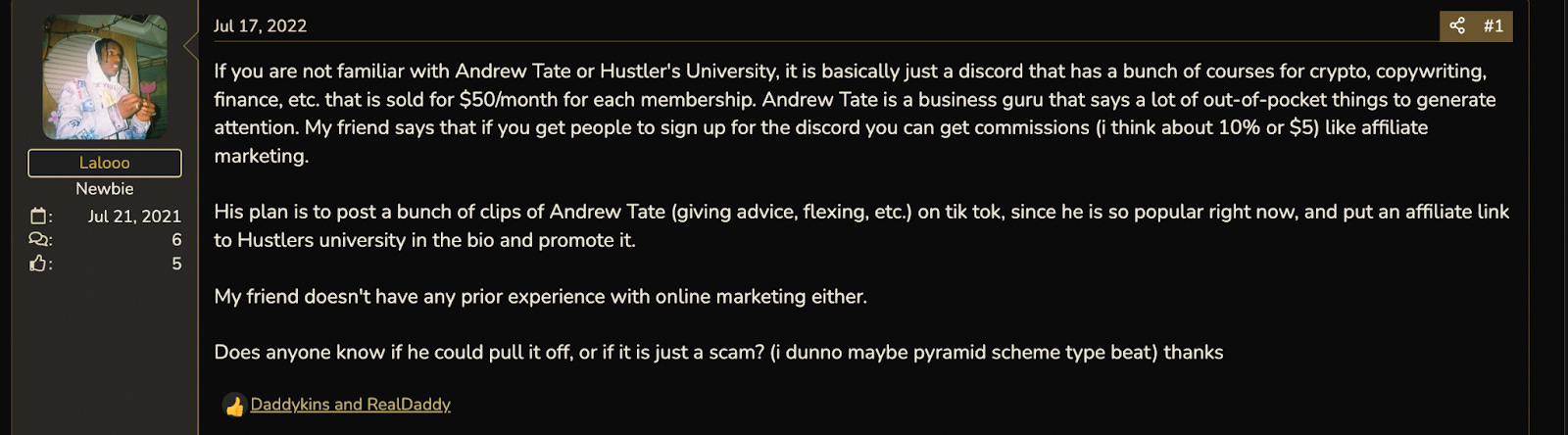
Andrew Tate is one of the first celebrities to primarily leverage a closed network platform to achieve fame. Tate got his start as a two-bit Internet course salesman but then layered on heavy affiliate marketing incentives to the closed network of his Hustlers University Discord and its Real World Affiliates program to grow his audience substantially by incentivizing them to flood open networks like TikTok with promotional content.
If you were on the Internet in 2022, you’ll remember how whiplash-inducing Tate's rise felt and how it felt like he appeared out of nowhere and then in every corner of the Internet before he was banned from TikTok, YouTube, Facebook and Instagram.
Even with those major platform bans, Andrew Tate has somehow only grown in influence and popularity in the past 3 years. Do you know how hard it is to get more popular after being banned from almost every major social media platform?
Tate's meteoric rise and maintenance of his popularity despite these blanket bans are strong evidence of the growing power of closed networks pre-AI ubiquity. Closed networks will become even more influential and grow exponentially once AI is ubiquitous.
We will see more vertical specific and interest-based, members-only, exclusive content-driven closed network platforms and closed subnetworks within larger open network platforms in the years to come.
Expect to see more versions of the Andrew Tate story, where there is a new digital creator that appears out of nowhere and you have no idea where they came from. It's not because you're getting old. They most likely came from a closed network.
This is the natural conclusion of the balkanization and filter bubbles that occur within algorithm-driven open network platforms today.